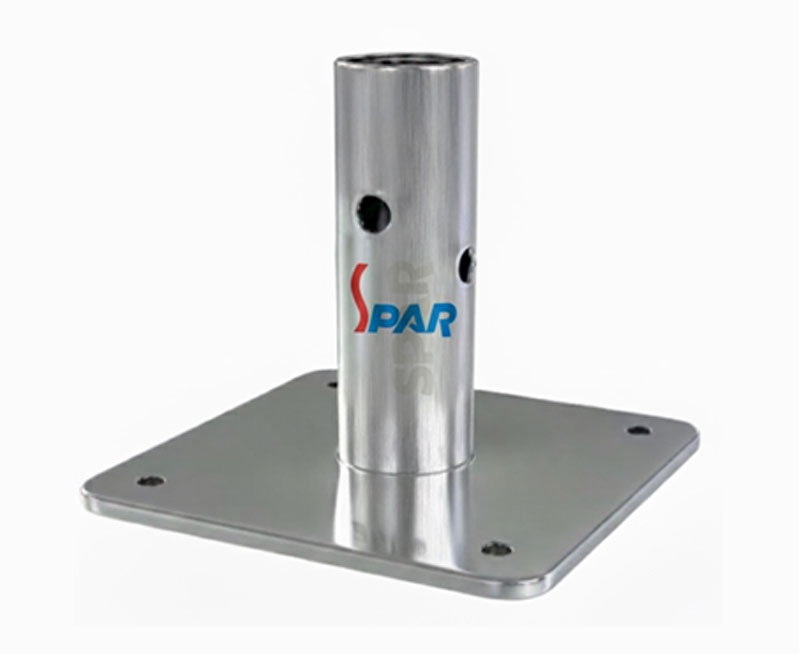
Product Overview

Cuplock Base Plate is the main load-spreading element that is placed under each standard or base jack. So, it delivers a stable, even distribution of vertical loads to the ground or floor surface, thus allowing scaffold structures to remain safe and stable, as well as properly aligned, throughout the working period.

Made from high-strength mild steel (S355) and hot-dip galvanized for corrosion resistance, the Base Plate is a durable product suitable for long-term use in industrial, petrochemical, and construction environments. It complies with Aramco GI 8.001 and SABIC 9.4 standards for scaffold foundation.

Key Features & Advantages

  • Load Distribution: Spreads concentrated loads to prevent settlement or ground failure.
  • Robust Construction: Fabricated from S355 steel with a 6–8 mm thick plate.
  • Galvanized Finish: Coating ≥ 85 µm per ISO 1461 ensures protection in marine and chemical zones.
  • Universal Compatibility: Fits 36 mm diameter base or universal jacks.
  • Dimensional Accuracy: Machined hole alignment for true vertical load path.
  • Maintenance-Free: Zero moving parts, easy to clean, and durable.

Technical Specifications

  • Material: Carbon Steel S355 (EN 10025)
  • Plate Type: Square / Flat, with central hole
  • Surface Finish: Hot-Dip Galvanized to ISO 1461
  • Manufacturing Standard: BS EN 74 / BS EN 12811
  • Hole Diameter: 38 mm (±0.5 mm)

Dimensional Data

Item Code Description Plate Size (mm) Thickness (mm) Hole Ø (mm) Weight (kg)
SP-BP-150 Base Plate 150 × 150 × 6 mm 150 × 150 6 38 1.8
SP-BP-150H Base Plate Heavy Duty 150 × 150 × 8 mm 150 × 150 8 38 2.3
SP-BP-175 Base Plate 175 × 175 × 6 mm 175 × 175 6 38 2.1
SP-BP-200 Base Plate 200 × 200 × 8 mm 200 × 200 8 38 2.9

Load Capacity & Structural Performance

Compliance & Certifications

Standard / Client Clause Description
Aramco GI 8.001 Sec. 5.4 Scaffold base support and foundation load distribution.
SABIC §9.4 Table 4 Grounding, base, and structural load compliance criteria.
BS EN 74 Clause 4 Material and mechanical performance for couplers and fittings.
BS EN 12811-1 Annex D Test methodology for scaffold component load capacity.
ISO 1461 Clause 6 Galvanizing coating verification.
ISO 3834-2 Clause 8 Welding and fabrication quality management.

Quality Assurance (QA / QC)

Inspection Procedure

  • Material verification using mill test certificate (MTC).
  • Dimensional check for size, flatness, and hole alignment.
  • Welding inspection (Visual + Magnetic Particle Testing).
  • Coating thickness check using calibrated Elcometer.
  • Static load testing under compression.
  • Final stamping and QA release documentation.

QA/QC Verification Summary

Inspection Stage Method Acceptance Criteria Frequency
Raw Material MTC Verification S355 JR / EN 10219 Each Batch
Fabrication Welds Visual + MT No cracks / full penetration 10 %
Dimensional Check Vernier / Jig ± 0.5 mm 100 %
Galvanizing Test Coating Gauge ≥ 85 µm Each Lot
Load Test Compression Frame ≥ 50 kN SWL Quarterly
Marking Visual Batch + Heat No. 100 %

Marking & Traceability

Each Base Plate carries a permanent stamp:

  • “ALTRAD SPAR– BASE PLATE – [Size] – [Batch No.] – [Heat No.] – [Year].”
  • QA inspector stamp and batch code for traceability.
  • Optional QR/barcode label for ERP integration.

Applications

  • Cuplock and Ringlock system foundations
  • Industrial and refinery scaffolding bases
  • Tank and pipeline scaffolding
  • Heavy-duty shoring and formwork towers
  • Power and infrastructure maintenance projects

Maintenance & Inspection

Item Frequency Method
Visual inspection Before each use Check for deformation, rust, or cracks
Flatness check Annually Use a steel straight edge
Proof load retest Every 5 years Verify ≥ 50 kN

Marking & Identification

Each Ledger is permanently stamped with:

  • “ALTRAD SPAR– LEDGER – [Length] – [Batch No.] – [Heat No.] – [Year]”
  • QA inspection mark and batch traceability reference.
  • Optionally available with QR/barcode labels for asset tracking in ERP systems.

Typical Applications

  • Industrial access scaffolds
  • Tank and vessel scaffolding
  • Bridge decks and suspended platforms
  • Formwork, bracing, and shoring grids
  • Maintenance structures in refineries and petrochemical plants

Maintenance & Inspection Guidelines

Item Frequency Method
Visual inspection before issue Every hire cycle Check blade ends, tube dents, and corrosion
Dimensional recheck Annual Verify length and blade seating
Proof load retest Every 5 years Hydraulic load validation as per BS EN 12811